

Scales for Guitarists – An Introduction
You’re a guitar-player huh? Pretty cool, but being a musician is way cooler! To be able to call yourself a musician, you really need to understand the building blocks of music – otherwise, you’re just somebody putting their fingers where they are told to without understand why! So let’s take a look at the first fundamental of music – scales.
Scales are the arrangement of notes in a pattern of intervals from one octave to the next. Scales are used for building melody lines in Lead Guitar, as well as well as being the notes we play in chords – they are essential to all musicians!
The Major Scale
There are many different types of scale, but the most common in western music is the major scale. You may not know you know it, but you do! All those nursery rhymes as a child – the major scale. Every happy pop-song you ever heard – the major scale. The theme tune of 90%+ of all TV shows – the major scale. The sound of music…. wait… what? Yep… The Sound of Music:
do re mi fa so la ti do
You guessed it – that’ll be a major scale. TAB and notation below:

Or to arrange it in the box shape we guitarists are more used to: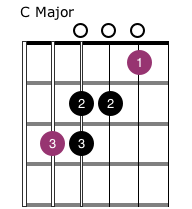
The purple notes are the root notes, and the numbers are the fingers I suggest you use – 1=Index, 2=Middle, 3=Ring & 4=Pinky. Recognise it now?
Scale Intervals
The intervals of a major scale are described in terms of tones and semitones, or whole and halftones (UK vs UK language differences as always). A tone being two frets distant from the previous note on a guitar, and a half or semi-tone being one fret. The intervals of a major scale are:
Tone-Tone-Semitone-Tone-Tone-Tone-Semitone if you’re in the UK. or;
Whole-Whole-Half-Whole-Whole-Whole-Half if you’re in the US.
The Internet seems to have settled on the latter, and you will often see intervals expressed as single letters – so the major scale would be WWHWWWH. You will notice that there are eight notes in the scales as written, and we call it an octave (octopus, octagon, oct=eight) but only seven intervals – well that’s because we’re only dealing in the distance between the note played and the next, and there are only seven gaps.
Play the third fret of the low E string (a G) and then use the WWHWWWH interval approach you should land on the 15th fret (which is also a G). If you didn’t, try again!
Each of the notes of the scale is given a number, expressed as a Roman Numeral, and these are called ‘Scale Degrees’. Each degree also has a name:
I – Tonic / Root
II – Supertonic
III – Mediant
IV – Subdominant
V – Dominant
VI – Submediant
VII – Leading note
You don’t need to remember the names, though root and dominant are useful in wider musical conversation. Leading note also makes sense because its defining characteristic is a need to slide up one more fret back to a root note, so the music sounds finished.
Intervals & Chords
It is worth knowing that chords are made up typically of roots, thirds and fifths – and all the fancy chords you’ve seen with numbers written on them? The numbers are the notes added.
Extra credit – chords including numbers beyond 7 have notes added in the second octave – a 9th is the 2nd octave II scale degree, an 11th is the 2nd octave IV scale degree and a 13th is a 2nd degree VI scale degree added to whatever the foundation chord is.
And that’s scales introduced – you should now understand what a scale is, what an interval is and how to articulate the notes of a scale like a musician!
You can find more articles on scales and guitar technique to help you develop as a player here, as well as the guitar grades here. If you’ve got any questions please get in touch on Facebook or Twitter, or leave a comment below.
And yeah, I know the theory stuff can seem a bit dull but trust me… it really helps you develop as a player. When everything starts falling it to place it’ll take you to heights you never thought possible!


