

Seventh Barre Chords
Chords are made up of notes in the corresponding scale, a major chord being the first, third and fifth notes in the sequence played together for example. In this lesson we will build on the major and minor barre chord shapes we learned in beginner barre chords to create seventh chords – major, minor and dominant. Six shapes that let you play any major, minor or dominant seventh chord on the whole guitar!
Sounds better than remembering all those different chords from before right? And best of all, we finally get to functionally forget the open B7 chord, which honestly is just horrible!
Performance Notes
The images that follow show a guitar fretboard as if you’re holding the guitar in front of you, with the nut being the thick black line at the top. An ‘O’ next to a string means play that string ‘open’ (no fingers on frets), an ‘X’ means the chord does not need that string to be played. The black dots direct you to place a fingertip in that location, with the numbers being the suggested finger to use – 1=Index, 2=Middle, 3=Ring, 4=Pinky. The coloured dots are the root notes – in an A chord the A is coloured, in a D chord it would be the note D that is coloured, and so on.
Make sure to alternate downstrokes, where you start strumming at the low E string (the Fat one) or the string closest to it required for the chord, and upstrokes starting with the high E (the Thin one), or the closest to it required for the chord. Doing this doubles your efficiency, and ultimately the speed you can play. Use enough pressure to get the notes to sound cleanly, moving your fingertip as close to the fret to the right (for a right-hander) will give you the best chance of a clean chord.
Barre Chord Technique
if you have worked through Grade 3, you should have some familiarity with the barre chord technique. Make sure to keep your thumb in the middle of the neck and apply even pressure across all strings, finger as close to the fret as possible to avoid fret-buzz.
You will find the increasingly intricate finger positions required for the seventh barre chords calls for patience and practice. A single strum of each chord is all that is required in the chord section of an exam, but an ability to move confidently between them is required for competent rhythm guitar. Practice regularly, and I recommend using your first finger barre as your ‘anchor’ point, dropping your fingers on to strings in order from there.
You may find the shapes described below easier to practice at the 12th fret, where string tension is lowest. If you need a refresher on barre chord technique you can check out the first video lesson here:
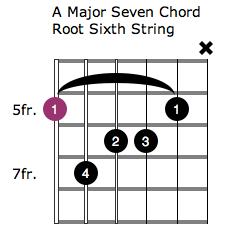
Major Seven Chords (maj7)
A major seventh chord is built from the first, third, fifth and seventh notes in the corresponding major scale. You don’t need to know that right now, but it is nice to know the note selections aren’t random! If you need a refresher on the diagrams, click HERE.
The examples given are at the 5th fret – if you move the root note up or down the fretboard you’ll get a different major seven chord. Move the 6th string shape down to the first fret for an F major seven, or up to the 10th fret for a D major seven. Move the 5th string shape to the 3rd fret for a C major seven, or to the 12th for an A major seven!
As you familiarise yourself with the chord shapes, it may help to remember that these shapes are based on the open Emaj7 and Amaj7 chords we learned in the Open Seventh Chords lesson. Play those shapes using your 2nd, 3rd and 4th fingers, leaving your index finger free to barre:

Minor Seven Chords (m7)
A minor seven chord is built from the first, flattened-third (the third note, but one fret back from major), fifth and flattened seventh notes in the corresponding major scale.
The examples given are at the 5th fret – if you move the root note up or down the fretboard you’ll get a different minor seven chord. Move the 6th string shape down to the third fret for a G minor seven, or up to the 12th fret for an E minor seven. Move the 5th string shape to the 2nd fret for a B minor seven, or to the 8th for an F minor seven!
As you familiarise yourself with the chord shapes, it may help to remember that these shapes are based on the open Em7 and Am7 chords we learned in the Open Seventh Chords lesson. Play those shapes using your 2nd, 3rd and 4th fingers, leaving your index finger free to barre:


In the Sixth string shape you don’t actually need to play the A string with your ring finger, you’re muting with it.
Dominant Seven Chords (7)
A dominant seven chord is built from the first, major third, fifth and flattened (minor) seventh notes in the corresponding major scale. The mix of a major and minor flavour in a single chord creates an interesting sound.
The examples given are at the 5th fret – if you move the root note up or down the fretboard you’ll get a different minor seven chord. Move the 6th string shape down to the third fret for a G dominant seven, or up to the 12th fret for an E dominant seven. Move the 5th string shape to the 2nd fret for a B dominant seven, or to the 8th for an F dominant seven!
As you familiarise yourself with the chord shapes, it may help to remember that these shapes are based on the open E7 and A7 chords we learned in the Open Seventh Chords lesson. Play those shapes using your 2nd, 3rd and 4th fingers, leaving your index finger free to barre:


Make sure you get the shapes under your fingers, just like the other lessons on barre chords. Aim to be able to play them on demand and switch confidently between them, as well as to and from the chords of previous grades. If you haven’t already memorised the guitar fretboard, check out the theory section – you’re going to need the bottom two strings down to be able to find the chord you need in every key!
These Exercises should help you to navigate between major and minor, and between chords rooted on the fifth and sixth strings. The tunes may seem familiar:
Exercise 1 – Smells like…?

Exercise 2 – When I come about

Exercise 3 – Under a Bridge
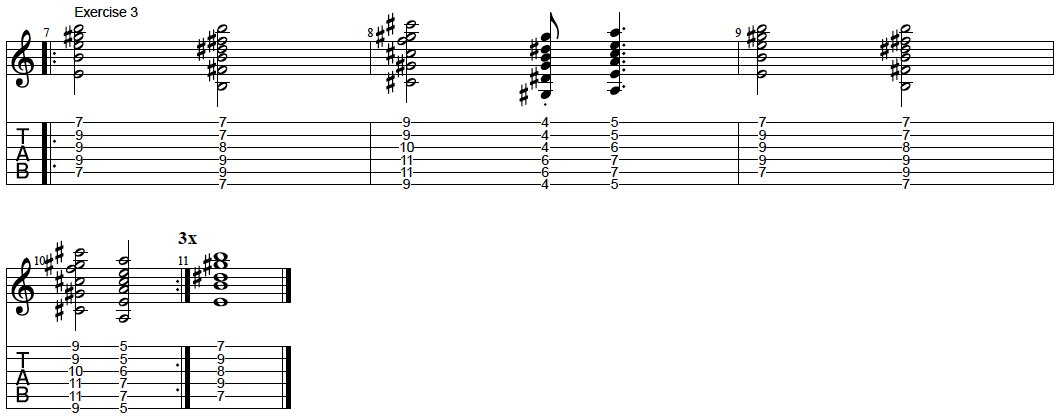
 You can download a PDF of the exercises HERE.
And that’s the Seventh Barre Chords done. You can find more articles on chords, scales and guitar technique to help you develop as a player here. If you’ve got any questions please get in touch on Facebook or Twitter.
And seriously, this sh*t ain’t easy.. so keep on working the patterns and don’t be one of the people who give up on guitar now!!! You’re so close to so much!


