

Music Theory for Guitar – Grade 1 – Part 4
Welcome back to Music Theory for Guitar – Grade 1, thanks for sticking with it!
Last time in Grade 1 Part III, we built on the key signatures and major scale construction of part two by adding scale degrees, intervals and triads. If you missed it or need a refresher, you can check out the first 3 parts of grade 1 music theory by following the links below:
Music Theory – Grade 1 – Part 1
Music Theory – Grade 1 – Part 2
Music Theory – Grade 1 – Part 3
This time, we’ll look at some commonly used symbols, beaming notes , musical directions and terms. There are several musical symbols and terms you’ll need to read grade 1 music pieces, and to satisfy the requirements of Grade 1 music theory. Some you will recognise and some you may not, I’m afraid there are no shortcuts for committing them to memory.
Musical Symbols
Below are the symbols you need to understand in Grade 1:
 Accent the note
 Staccato (detached). Play the note short
 Pause (fermata). Hold the note for longer than note value
 Tie. The two notes should be played as one. Only the first is played
 Legato, or slur. The notes should be played fluidly and smoothly as one phrase
 Repeat. Go back to the beginning and repeat the section (2nd pass play straight through
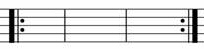 Double repeat bars mean to repeat everything between the two markers
 Crescendo (cresc.). Gradually getting louder
 Decresendo or Diminuendo (dim). Gradually getting quieter.
It may help you to think of the symbols for volume on home audio devices to remember the last two.
Beaming Notes
We use beams to group quavers (8th notes) together into beats. When beaming quavers you can join 6 together in a bar of 3/4 or a maximum of 4 together in 4/4, but the 4 must not be across the middle of the bar (beats 2 and 3). You can also beam together dotted quavers and semiquavers, or quavers and semi quavers, see below:
 Musical Terms
It will no doubt please you to learn (?) that all musical directions are in other languages. At this grade the terms you need to know are Italian, but French and German are also common. The list below are those required for grade one, the figures in brackets show abbreviations commonly used in notation:
A tempo – At the original speed /time
Accelerando (Acc.)- Gradually getting faster
Adagio – Slowly
Allegretto – Fairly quick
Allegro moderato – Moderately quick
Andante – At a walking pace
Cantabile – In a singing style
Crescendo (cresc.) – Gradually getting louder
Da capo (DC) – From the beginning
Dal segno – From the sign
Decrescendo – Gradually getting quieter
Diminuendo (dim.)- Gradually getting quieter
Fine – End
Forte (f)- Loud
Fortissimo (ff) – Very loud
Legato – Smoothly
Lento – Slow
Mezzo – Half
Mezzo forte (mf) – Moderately loud
Mezzo piano (mp) – Moderately quiet
Moderato – Moderately
Pianissimo (pp) – Very quiet
Piano (p) – Quiet
Poco – A little
Rallentando (rall) – Gradually getting slower
Ritardando (rit.)- Gradually getting slower
Ritenuto – Held back
Staccato – detached
And that, together with the first three parts completes the syllabus for music theory grade 1. Be sure to check out some sheet music so you can see some of these in practice. Next time, a quiz to show you how this is applied to real music, and to check we’re on track so far.
See you again in Music Theory – Grade 1 – Part 5.
You can find more articles on scales and guitar technique to help you develop as a player here. If you’ve got any questions please get in touch on Facebook or Twitter.


