

The Scale:
There are many ways in which to play a minor pentatonic scale. We’ll use the key of A and what is known as ‘position 1’ as a logical beginning:
Ascending

Descending

The Box

The Theory
The pentatonic scale is so named because it only has five notes – the root, flattened third, fourth, fifth and flattened seventh degree (or note) of the parent major scale, which for Am Pentatonic means A, C, D, E & G. Position 1 shown above is probably the most popular way to play an Am scale, perhaps because your index finger never needs to move from the 5th fret and the notes fall neatly under your fingers with practice. The pentatonic scales are very popular across musical genres, but especially in rock. It’s difficult to hit a bad note when you’re only using 5 of them. If you are not familiar with this scale, memorize the shape and get practicing!
Some Example licks
1) Double Stops

2) Alternate pick or Legato, it’s up to you:
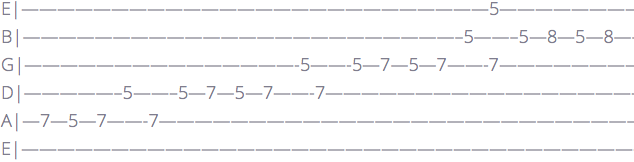
3) Hammettish
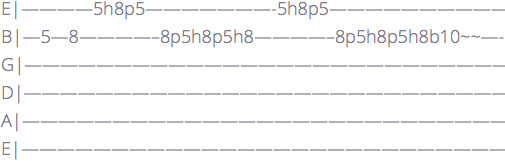
4) A Classic

Hammer ons: h.
Pull offs: p.
Vibrato: ~.
Bends: b.
Release bend: br.
Slides: /
The Extra Flash
Once you’ve grasped the material above and want to move on to blasting up and down the fretboard instead of being stuck in a box, check out the diagram below, which shows you the five positions of a minor pentatonic scale. If you start at the 5th fret, it’s an A minor pentatonic. Move it up 2 frets and you’ve got a B minor pentatonic, another fret to C… and so on.

And that’s the minor pentatonic scale for you. You can find more articles on scales and guitar technique to help you develop as a player here. If you’ve got any questions please get in touch on Facebook or Twitter.
Happy noodling!


