

We spend a lot of time around here on style and technique, polishing playing to reach ever-greater heights. But true mastery of an instrument can only come with an appreciation for musical constructs. Knowing where to put your fingers is mechanically useful, and remembering hundreds of chord shapes demonstrates a powerful memory, but neither make you a musician. Being a musician demands knowledge, and in this lesson, we’re going to look at building chords.
What is a chord?
‘A chord is a load of notes, which played together sound decent’ – Yep, that’s about it. But if you grabbed a guitar and started trying to find notes within range of each other that ‘sound decent’, you might be at it a while before you happened upon anything useful or usable. So to take the guesswork out of it, we’re going to look at building chords.
Building Chords
To understand how all your favourite guitarists are building we need to take a trip back to Music Theory 101, and look again at the Major Scale as we did HERE. Basic western musical harmony in a major key boils down to the major scale. Probably not a surprise, that!
do re mi fa so la ti do
If you checked out the link above, you’ll know that’s a major scale – TAB and notation for C Major below:

You might also remember that each note of the scale is given a number, expressed as a Roman Numeral, and these are called ‘Scale Degrees’. Each degree has a name:
I – Tonic / Root
II – Supertonic
III – Mediant
IV – Subdominant
V – Dominant
VI – Submediant
VII – Leading note
Intervals and Chords
Chords are built with Triads – The Root, Third and Fifth notes of a major scale making the corresponding major chord. If we built a triad from G major we would have a major triad – G, B & D and if we built a triad from the second degree we would get A, C & E – a minor triad.

When we continue building triads on each degree of the scale the chord pattern would be Major, minor, minor, Major, Major, minor, Diminished and then back to Major.
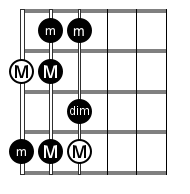
Then if we wanted to add some extra colour to those chords, the seventh chords follow a very similar pattern.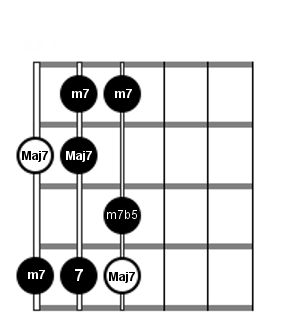
The reason for a dominant 7th chord on the fifth degree of the scale is because the flattened seventh belongs to the scale. If we tried to build a major seventh chord on the fifth degree, the seventh of that chord would not belong to the scale. For the same reason, we use a flattened fifth on the seventh degree of the scale, resulting in a minor 7 flat 5 (m7b5) chord on the seventh degree, rather than a full diminished.
Beyond the Octave
Extra credit – chords including numbers beyond 7 have notes added in the second octave – a 9th is the 2nd octave II scale degree, an 11th is the 2nd octave IV scale degree and a 13th is a 2nd degree VI scale degree added to whatever the foundation chord is.
You can find more articles on scales and guitar technique to help you develop as a player here, as well as the guitar grades here. If you’ve got any questions please get in touch on Facebook or Twitter, or leave a comment below.
And yeah, I know the theory stuff can seem a bit dull but trust me… it really helps you develop as a player. When everything starts falling it to place it’ll take you to heights you never thought possible!


