

Songwriting for Guitarists – An Introduction
Playing the guitar is fun for sure – when you start out you’re probably playing along to your favourite songs, trying to play a crazy solo from a record or maybe playing through chord charts and examples from books. All really awesome and part of the musician’s journey. You know what’s 100 times cooler? Writing your own songs! And with that, I bring you Songwriting for Guitarists.
Now, I say ‘Song’ – There don’t need to be any lyrics, and this songwriting for guitarists lesson is focussed on musical harmony. The structures in western music that make something work or not work for our ears. We need to head back to Music Theory 101, and look again at the Major Scale, as we did HERE. Basic western musical harmony in a major key boils down to the major scale. Probably not a surprise, that!
do re mi fa so la ti do
If you checked out the link above, you’ll know that to be a major scale, you might also remember that each note of the scale is given a number, expressed as a Roman Numeral, and these are called ‘Scale Degrees’.
Diatonic Harmony
‘Whoa… easy there Ren… that sounds complicated!’
Yeah, I suppose it does… but it isn’t! Chords are built with Triads – The Root, Third and Fifth notes of a major scale making the corresponding major chord. If we built a triad from G major we would have a major triad – G, B & D and if we built a triad from the second degree we would get A, C & E – a minor triad.

When we continue building triads on each degree of the scale the chord pattern would be Major, minor, minor, Major, Major, minor, Diminished and then back to Major.
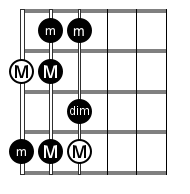
And if we wanted to add some extra colour to those chords, the seventh chords follow a very similar pattern.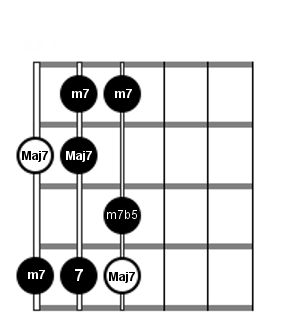
Practical Examples
‘So, that’s all great… but how does all that relate to songwriting for guitarists?’, I hear you ask.
What it means in simple terms is, if you’re playing in the key of G major you will want to use a combination of the following chords:
G Major, A minor, B minor, C major, D major, E minor and F# diminished
Playing lead guitar in the same key, you could consider:
G major (Ionian), A Dorian, B Phrygian, C Lydian, D Mixolydian, E Minor (Aeolian) and F# Locrian
Some of the modal stuff is pretty advanced, so if that’s all a bit much just concentrate on G major and its relative minor – Em.
And the patterns as always are mobile and transposable, so if you’re playing in A major, shuffle everything above up a tone (2 frets) and follow the same logic – it is most important to remember the intervals of the scale and the order of the chords.
Put it into Practice – Write your Own Music!
Armed with the information above, you should be able to start building chord progressions in a key, and by doing so create music that sounds ‘right’. It is also cool to break the rules, but I think it is important to know what the rules are, and break them on purpose rather than by accident! And that, ladies and gentleman, is songwriting for guitarists.
You can find more articles on scales and guitar technique to help you develop as a player here, as well as the guitar grades here. If you’ve got any questions please get in touch on Facebook or Twitter, or leave a comment below.
And yeah, I know the theory stuff can seem a bit dull but trust me… it really helps you develop as a player. When everything starts falling it to place it’ll take you to heights you never thought possible!


